> ## Documentation Index
> Fetch the complete documentation index at: https://docs.0xarchive.io/llms.txt
> Use this file to discover all available pages before exploring further.
# Opening sweeps
> Large taker orders that walked the book, split by whether they opened positions or closed them.
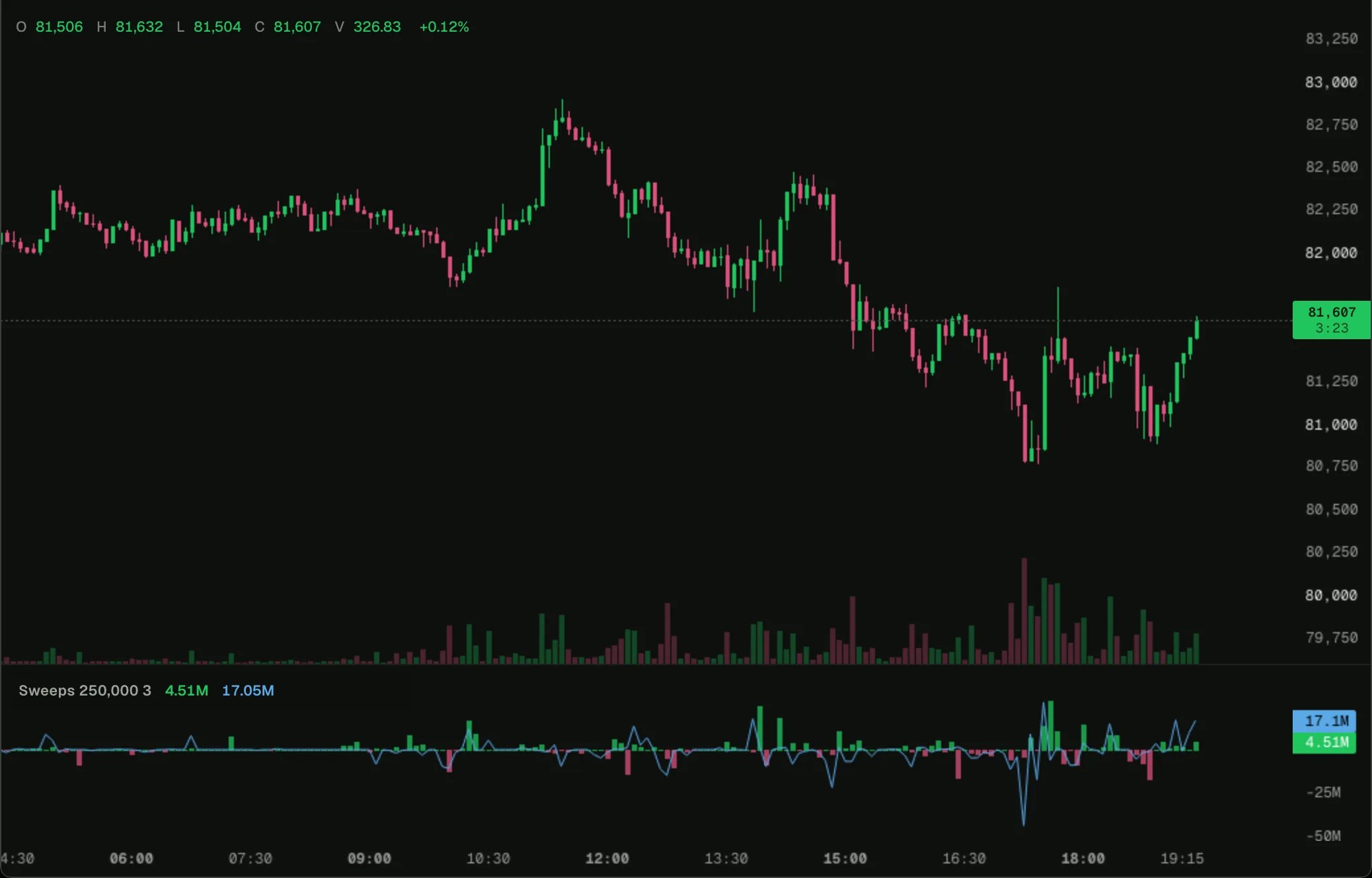 Load it on BTC 5m in the terminal, then change its settings or open it in the script editor.
A sweep is one market order big enough to eat through several prices of the book. On a chart of trades it is a burst of separate prints; joined back into its order, it is one decision by one taker. This script keeps the orders of \$250k or more that filled at three prices or more and asks what each did to open interest, from the sum of its fills' `oiDelta`:
| Sweep | What happened |
| - | - |
| Buy, open interest up | Bought into new positions |
| Buy, open interest down | Bought out of positions: shorts covering |
| Sell, open interest up | Sold into new positions |
| Sell, open interest down | Sold out of positions: longs exiting |
The bars are **opening sweeps**: buys less sells, in USD. The line is **closing sweeps**. Aggression that opens is a taker committing to a side; aggression that closes is a taker leaving one.
## How it works
[`takerOrders()`](/terminal/guides/order-flow#taker-orders) joins the fills into orders and calls `onOrder` once per order, once all its fills are in, so a forming bar never sees half a sweep. `minNotional` counts the whole order, and `levels` is how many prices it filled at. Two [tallies](/terminal/guides/state#tallies) collect the bar's sweeps, one for each kind. An order whose fills moved no open interest on net counts in neither, and neither does one with a fill the venue did not report.
## Try changing
* Raise **Prices walked** to keep only the orders that moved the price the furthest.
* Lower **Smallest order** on a smaller market: \$250k sweeps are common on BTC and rare on most others.
## The script
```ts opening-sweeps.ts theme={"theme":"github-dark"}
// Large taker orders that walked the book, split by what they did to open interest. A sweep that
// raised open interest opened positions; one that lowered it closed them. Opening sweeps are the
// bars, buys up and sells down; closing sweeps are the line, in USD per bar. Each order is joined
// from its fills, and its change in open interest is the sum of theirs, which 0xArchive records on
// every print.
indicator('Opening sweeps', { shortName: 'Sweeps' });
const minUsd = input.float('Smallest order ($)', 250_000, { min: 0 });
const minLevels = input.int('Prices walked, at least', 3, { min: 1, max: 100 });
const chart = bars();
const orders = takerOrders({ minNotional: minUsd });
const opening = tally();
const closing = tally();
const openingBars = plot.histogram('Opening sweeps $');
const closingLine = plot.line('Closing sweeps $', { color: color.study(12), width: 1 });
orders.onOrder((o) => {
// na: some fill's change in open interest is unknown. 0: what opened on one side closed on the other.
if (o.levels < minLevels || isNa(o.oiDelta) || o.oiDelta === 0) return;
const usd = o.side === 'buy' ? o.notional : -o.notional;
(o.oiDelta > 0 ? opening : closing).add(usd);
});
chart.onBar(() => {
// Trades reach back to the chart's first bar, at most 7 UTC days; older bars stay empty.
if (!orders.available) return;
openingBars.set(opening.value, color.withAlpha(opening.value >= 0 ? color.up : color.down, 0.75));
closingLine.set(closing.value);
});
```
## Next step
See the next example, [Liquidations](/terminal/examples/liquidations).
This documentation is built and hosted on [Mintlify](https://mintlify.com), a developer documentation platform.
Load it on BTC 5m in the terminal, then change its settings or open it in the script editor.
A sweep is one market order big enough to eat through several prices of the book. On a chart of trades it is a burst of separate prints; joined back into its order, it is one decision by one taker. This script keeps the orders of \$250k or more that filled at three prices or more and asks what each did to open interest, from the sum of its fills' `oiDelta`:
| Sweep | What happened |
| - | - |
| Buy, open interest up | Bought into new positions |
| Buy, open interest down | Bought out of positions: shorts covering |
| Sell, open interest up | Sold into new positions |
| Sell, open interest down | Sold out of positions: longs exiting |
The bars are **opening sweeps**: buys less sells, in USD. The line is **closing sweeps**. Aggression that opens is a taker committing to a side; aggression that closes is a taker leaving one.
## How it works
[`takerOrders()`](/terminal/guides/order-flow#taker-orders) joins the fills into orders and calls `onOrder` once per order, once all its fills are in, so a forming bar never sees half a sweep. `minNotional` counts the whole order, and `levels` is how many prices it filled at. Two [tallies](/terminal/guides/state#tallies) collect the bar's sweeps, one for each kind. An order whose fills moved no open interest on net counts in neither, and neither does one with a fill the venue did not report.
## Try changing
* Raise **Prices walked** to keep only the orders that moved the price the furthest.
* Lower **Smallest order** on a smaller market: \$250k sweeps are common on BTC and rare on most others.
## The script
```ts opening-sweeps.ts theme={"theme":"github-dark"}
// Large taker orders that walked the book, split by what they did to open interest. A sweep that
// raised open interest opened positions; one that lowered it closed them. Opening sweeps are the
// bars, buys up and sells down; closing sweeps are the line, in USD per bar. Each order is joined
// from its fills, and its change in open interest is the sum of theirs, which 0xArchive records on
// every print.
indicator('Opening sweeps', { shortName: 'Sweeps' });
const minUsd = input.float('Smallest order ($)', 250_000, { min: 0 });
const minLevels = input.int('Prices walked, at least', 3, { min: 1, max: 100 });
const chart = bars();
const orders = takerOrders({ minNotional: minUsd });
const opening = tally();
const closing = tally();
const openingBars = plot.histogram('Opening sweeps $');
const closingLine = plot.line('Closing sweeps $', { color: color.study(12), width: 1 });
orders.onOrder((o) => {
// na: some fill's change in open interest is unknown. 0: what opened on one side closed on the other.
if (o.levels < minLevels || isNa(o.oiDelta) || o.oiDelta === 0) return;
const usd = o.side === 'buy' ? o.notional : -o.notional;
(o.oiDelta > 0 ? opening : closing).add(usd);
});
chart.onBar(() => {
// Trades reach back to the chart's first bar, at most 7 UTC days; older bars stay empty.
if (!orders.available) return;
openingBars.set(opening.value, color.withAlpha(opening.value >= 0 ? color.up : color.down, 0.75));
closingLine.set(closing.value);
});
```
## Next step
See the next example, [Liquidations](/terminal/examples/liquidations).
This documentation is built and hosted on [Mintlify](https://mintlify.com), a developer documentation platform.